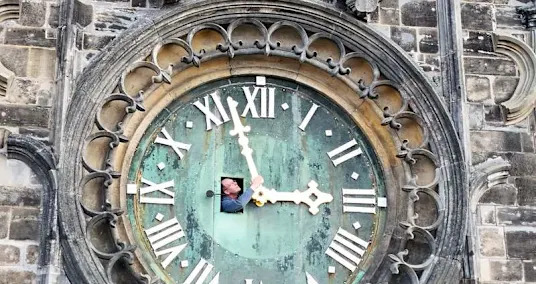
Clocks across the majority of European countries are set to go forward by one hour early on Sunday as the continent moves to daylight saving time, also known as summer time.
Clocks in most European nations including Germany advance by one hour at 2 am (0100 GMT) to 3 am, heralding longer evenings and brighter days.
This means that for the coming months parts of Europe will be on Central European Summer Time (CEST), before moving back to Central European Time (CET) in the autumn, when clocks go back again by an hour on October 25.
The aim of the change is to make better use of daylight in the shorter days of the winter in the northern hemisphere.
The signal for the automatic changeover of the clocks in Germany comes from the Federal Institute of Physics and Metrology (PTB) in the northern city of Braunschweig, also known as Brunswick in English.
The institute's experts ensure that radio-controlled clocks, station clocks and many industrial clocks are supplied with the signal via a long-wave transmitter called DCF77 in Mainflingen near Frankfurt.
latest_posts
- 1
 Gulf of Mexico oil spill spread hundreds of miles, killed wildlife and polluted Mexican reserves
 - 2Huge Iranian missile fragments, intercepted by air defenses, lay scattered across Israel, West Bank
- 3Step by step instructions to Look at Compact disc Rates: A Thorough Aide
- 4Traveling Alone: An Excursion of Self-Disclosure
- 5More people are addicted to marijuana, but fewer of them are seeking help, experts say




- Bronze Age "City of Seven Ravines" unearthed in central Asia after 3,500 years
- Experts who once backed 'shaken baby' science now fight to free imprisoned caregivers
- Instructions to Warmly greet Certainty and Appeal
- Astronomer captures 2 meteors slamming into the moon (video)
- Excelling at Discussion: Genuine Examples of overcoming adversity
- Timex Gives Its Classic Affordable Field Watch a Tactical, Milspec Makeover
- Did Japan’s PM Actually Back the Memecoin Bearing Her Name?
- Greenland’s melting ice and landslide-prone fjords make the oil and minerals Trump is eyeing dangerous to extract
- From Dread to Certainty: Individual Accounts of Strengthening